
A Guide to Taxes in 2026 (Plus Free Tax Table Download!)

Understanding how taxes work – and what you may owe – is a critical part of financial planning. No matter where you are in life, from preparing to retire or simply aiming to contribute to your future retirement, knowing your current income bracket, current capital gains rates, and contribution limits can make tax season much easier.
Below, download your complimentary 2025-2026 Tax Table. Then, follow along in this guide as we break down key components, including standard deductions, IRA contribution limits, and phaseouts for retirement accounts. With this information, you can make more informed decisions and take advantage of potential tax saving opportunities this year.
Download your complimentary 2025-2026 Tax Table
Your Income Tax Bracket for 2026
Your taxable income is typically one of the most significant drivers to your total tax liability year to year. Not only does this determine your tax bracket, but it also factors into your capital gains rate and net interest income tax. Additionally, it plays a role in your ability to utilize certain investment vehicles.
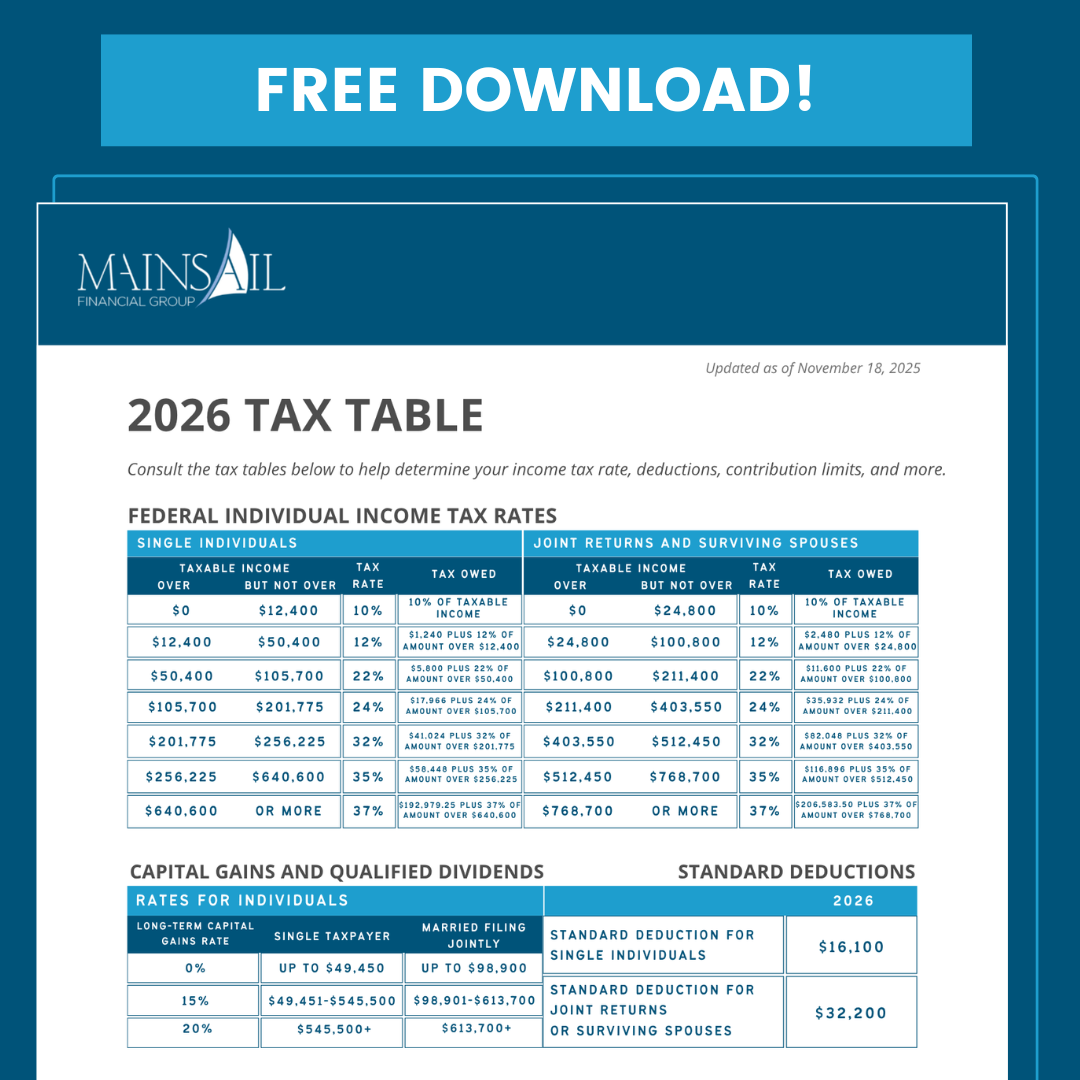
One thing that is often misunderstood with the current tax brackets is that our tax system works as a progressive tax. This means that for joint filers who make $210,000 of taxable income in 2026, not every penny of that $210,000 is taxed at the 22% bracket that you fall into. Rather, the first $24,800 is taxed at 10%, then the next $76,000 is taxed at 12%, and the remaining portion over $100,800 would be taxed at the 22% rate. This puts a little less pressure on taxable income amounts from the tax bracket perspective where if someone falls just one dollar above a threshold, they do not suddenly have a much higher total tax rate and bill.
As you follow along the chart in the tax table, you will see the calculations that give you a sense of the total tax liability you may expect depending on which bracket you fall in to. If you divide this total tax liability by your total taxable income, you will get what is called your effective tax rate, which is a blend of the tax rates you see in the chart and, most of the time, will come out with a number entirely different from any given bracket percentage. The marginal tax rate would be the additional tax percentage paid on every dollar earned as income above each threshold. From the example earlier, it would suggest every additional dollar earned for this family would come with a marginal tax rate of 22% up until the next bracket that starts at $211,401.
Calculating Your Capital Gains Tax Rates in 2026
Capital gains tax rates are often overlooked. Although most may fall into the 15% capital gains tax bracket, it is important to know that some may actually qualify for a 0% capital gains tax and others may be subject to the 20% level. This rate is based on your total taxable income, which generally includes capital gains, dividends, employment income, and more, and increases depending on where your total income falls in that tax year.
Please do keep in mind that short-term capital gains are treated, and therefore taxed, as ordinary income. Any short-term gains will follow the income tax brackets mentioned above. That said, long-term gains on investments held for over a year are taxed at capital gains rates.
This is why strategic tax planning is so important even within the investment strategy itself, as transactions with investments outside of retirement accounts may come with tax implications. It is also important to note that assets sold at a loss can be captured as “capital losses” and those losses may be used to offset any gains in the same tax year.
Although this covers the capital gains tax itself, higher income earners do also need to be aware of the Net Investment Income Tax (NIIT) which is an additional 3.8% rate for married filing jointly with modified adjusted gross income (MAGI) over $250,000 and single filers over $200,000.
The 2026 Standard Deduction
The standard deduction has increased in 2026 and is now $32,200 for joint returns and $16,100 for single filers.
It is important to note that these higher standard deduction levels began in 2017 as part of the Tax Cuts and Jobs Act (TCJA) which is to sunset at the end of 2025. Last year, we saw the introduction of the One Big Beautiful Bill Act (OBBBA) which increased the standard deduction, providing higher tax-free income thresholds for taxpayers.
Annually, your tax circumstances are run as part of filing your taxes, whether you prepare them yourself, with the help of a CPA, or via tax software. Based on your tax scenario in that year, your circumstances identify what would qualify for itemized deductions versus what you would receive with the standard deduction. If your itemized deductions add up to over $32,200 for joint filers or $16,100 for single filers, you would utilize the itemized deductions, of course, for a more favorable tax scenario. On the other hand, if these itemized deductions add up to a lower amount than the standard deductions, you would take the standard deduction to reduce your taxes.
Many who were itemizing prior to these legislative changes have realized the higher standard deduction is much more beneficial today, so many choose not to itemize their deductions and opt for the higher standard deduction. This does not mean the tax benefit has been lost, it simply means it takes a much higher itemized deduction threshold to see a benefit over the higher standard deduction.
As a result, it has become more typical that those making charitable contributions are not receiving the additional tax benefits they once experienced. This is where bunching gifts and other charitable giving strategies may help to reduce taxation as effectively as possible, even with the higher standard deduction.
Are you prepared for taxes in retirement?
For more long-term tax planning strategies, claim your FREE copy of Brandon’s book, Retire by Design!
2026 Retirement Contribution Limits and Catch Ups
Each calendar year, the IRS adjusts contribution limits for retirement plans to account for inflation. Some of the most notable changes for 2025 include 401(k)/403(b), IRAs, and HSAs. Below, we cover each of these plan types in more detail.
2026 Retirement Plan Limits for 401(k)/403(b)
The limit for 401(k) and 403(b) plans is $24,500 for 2026, up from $23,500 last year. If you are age 50 or older, you also are allowed a “catch-up” contribution to encourage additional savings, which is $8,000 this year, up from $7,500 in 2025, for a total maximum contribution of $32,500. Additionally, again this year is an additional “catch up” provision for those ages 60, 61, 62, or 63 of $11,250.
The other adjustment is to total contributions. The adjustment to the TOTAL limit for these plans has increased to $72,000 ($80,000 including catch up contributions and for those who are 60-63, $83,250) in 2026 from $70,000 ($77,500 including catch up contributions) in the previous year. These amounts include employer contributions, after-tax contributions, etc., and are the absolute maximum amount that can be contributed to these plans in a given year.
2026 Retirement Plan Limits for Traditional IRAs and Roth IRAs
In 2026, the IRS has increased the contribution limit for IRAs. In 2026, savers can contribute $7,500, up from $7,000 in 2025. There is also an additional $1,100 “catch-up” contribution available to those 50 and older for a total of up to $8,600. Please keep in mind that IRAs and Roth IRAs have income considerations, which have been adjusted for 2026, so be sure to review these income thresholds before making contributions.
2026 Retirement Plan Limits for HSAs
In 2026, the family plan maximum contributions increased $200 for a total of $8,750. Individuals also increased by $100 to a level of $4,400 for 2026.
For even more contribution limits, including employee and business plans such as SEP IRAs and SIMPLE IRAs, visit our guide to 2026 contribution limits!
IRA Income Phaseouts in 2026
For higher earners, the IRS may not allow you to contribute to IRA accounts. These vehicles were designed to help savers with a lower income take advantage of tax deferred and tax-free growth. For higher earners, however, the tax code attempts to prohibit those from saving towards these accounts.
In 2026, joint filers making over $129k begin to “phase out” of eligibility to receive the tax deduction on traditional IRA contributions. This means the contribution amount you are eligible to deduct may be prorated (see contribution limits above) and those joint filers with AGI over $149k may be completely ineligible. For single filers, that range is $81k-$91k.
Separately, joint filers making over $242k begin to phase out of eligibility to contribute to a Roth IRA at all and are completely ineligible with AGI above $252k. For single filers, this range is $153k-$168k.
That said, there may be strategic ways to reduce AGI to allow eligibility. Separately, exploring options such as backdoor Roth IRA contributions with your financial planner will allow you to still save into these vehicles where appropriate.
Navigating the complexities of the tax system can feel overwhelming, but understanding these essential components including your income brackets, capital gains rates, deductions, and contribution limits can help you plan more effectively. By staying informed about current thresholds and limits, you can reduce your tax liability and optimize your financial strategy. Be sure to download our complimentary 2025-2026 Tax Table to discover the latest figures for your specific tax scenario.
Whether you are saving for retirement or managing your investments, using these tables as a guide will ensure you’re making the most of opportunities within the tax code. If you have any questions about how these rates and limits may apply to you, please reach out to a member of the Mainsail advisory team below for a complimentary consultation!
Advisory services offered through Mainsail Financial Group, LLC, a Registered Investment Adviser. For informational purposes only, not intended as tax advice. Please consult a tax professional when appropriate.